

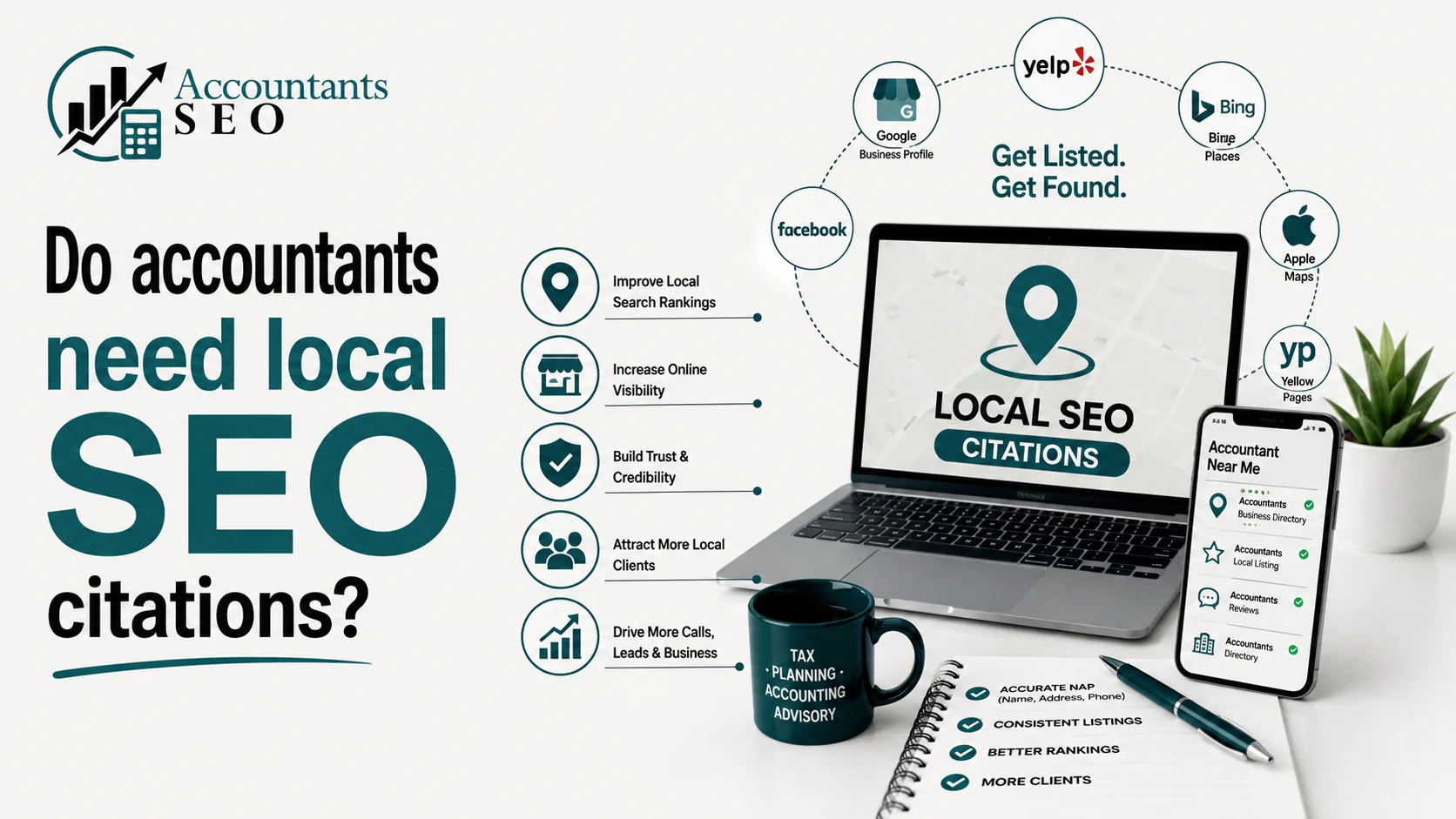
If you’re running an accounting firm, you’ve probably invested time into building a professional website, publishing tax advice, and maintaining client relationships. But there’s another piece of the puzzle that many firms overlook local SEO citations. These online mentions of your business name, address, and phone number (NAP) help search engines verify that your accounting practice is legitimate, trustworthy, and relevant to local searchers.
The accounting industry has become increasingly competitive, especially as more people search online for phrases like “accountant near me,” “tax accountant in [city],” or “small business accountant.” Recent local SEO research shows that 84% of consumers search online for local businesses daily, while 97% read reviews before choosing a local service provider. These statistics highlight just how important local visibility has become for professional service businesses like accounting firms.
The short answer is yes accountants absolutely need local SEO citations. However, modern citation building is no longer about submitting your business to hundreds of random directories. Today’s local SEO focuses on quality, consistency, relevance, and trust rather than sheer quantity.
When combined with a well-optimized Google Business Profile, positive client reviews, and location-specific website content, citations strengthen your firm’s authority and improve your chances of appearing in Google’s Local Pack and organic search results.
Understanding Local SEO Citations
Local SEO citations are online references to your accounting firm’s Name, Address, and Phone Number (NAP) across trusted websites, directories, business listings, and local platforms. They may also include your website URL, business hours, services, email address, customer reviews, and even photos of your office.
Search engines use these citations as trust signals to confirm that your business is genuine and operates at the location you claim. Every consistent citation acts like another vote of confidence, helping Google feel more comfortable recommending your accounting firm to local searchers.
Think of citations as digital business cards scattered across the internet. When every business card contains identical information, it creates a strong and reliable identity. If one listing shows an old phone number, another displays a previous office address, and another uses a different business name, search engines become uncertain about which information is accurate. That uncertainty can reduce your visibility in local search results, even if your website is well optimized.
For accountants, citations are particularly valuable because financial services require a high level of trust. Before contacting an accountant, many potential clients verify the firm’s legitimacy by checking multiple websites. They might compare Google Business Profile, Yelp, local chamber directories, professional accounting associations, and social media profiles. Finding the same business information everywhere reassures potential clients that they are dealing with a professional and established practice.
Local citations also support other SEO efforts rather than replacing them. A beautifully designed website alone cannot maximize local rankings if your online business information is inconsistent. Likewise, citations alone won’t guarantee first-page rankings without quality content and positive client reviews. The strongest local SEO strategy combines citation management, review generation, optimized service pages, technical SEO, and a complete Google Business Profile into one cohesive marketing approach.
What Are Local Citations?
A local citation is any online mention of your accounting business, whether or not it includes a direct link to your website. While backlinks pass SEO authority, citations primarily help search engines validate business information and improve local relevance. They provide context about your firm’s location, services, and legitimacy, making them an essential component of local search optimization.
There are two primary forms of citations. Structured citations appear on business directories where your information is entered into standardized fields, such as business name, address, phone number, website, and operating hours. Examples include Google Business Profile, Bing Places, Yelp, Apple Maps, and Yellow Pages. These are the citations that most directly influence local SEO because search engines can easily read and compare the information across multiple sources.
Unstructured citations, on the other hand, appear naturally within articles, blog posts, news websites, local publications, sponsorship pages, or community event listings. For example, if a local newspaper publishes an article about your accounting firm’s free tax workshop and mentions your company name and location, that counts as an unstructured citation. While these are less standardized, they still contribute to your online authority and brand recognition.
The value of citations has evolved significantly over the years. Search engines now prioritize relevance and accuracy instead of volume. Rather than creating hundreds of low-quality directory listings, accounting firms should focus on earning listings on reputable business directories, industry-specific websites, trusted local organizations, and government-related business resources. Quality always outweighs quantity in today’s local SEO landscape.
Types of Local SEO Citations
Not every citation carries the same weight. Some directories are recognized globally, while others have strong influence within specific industries or geographic regions. Understanding the different types of citations helps accountants build a smarter local SEO strategy instead of wasting time on directories that provide little value.
The first category includes major business directories. These platforms are widely trusted by both users and search engines. Examples include Google Business Profile, Bing Places, Apple Maps, Yelp, Facebook Business, Better Business Bureau, and Yellow Pages. Every accounting firm should establish complete and accurate profiles on these authoritative platforms because they often appear directly in search results and map listings.
The second category consists of industry-specific directories. These directories cater specifically to accounting professionals, tax advisors, financial consultants, and certified public accountants. Listings on professional accounting associations, CPA directories, bookkeeping networks, and financial service platforms reinforce your firm’s expertise within the accounting industry. Because these citations are highly relevant, they often provide stronger trust signals than generic directories.
A third category includes local citations from community organizations. Chambers of commerce, local business associations, city business directories, nonprofit sponsorship pages, educational institutions, and local event websites all contribute to a firm’s geographic relevance. If your accounting firm sponsors community events or partners with local organizations, these mentions create valuable citation opportunities while also strengthening your local reputation.
Finally, there are social and niche citations, including LinkedIn Company Pages, Facebook Business profiles, local networking groups, and professional forums. While these may not carry the same ranking influence as structured business directories, they increase your firm’s visibility, encourage engagement, and help potential clients discover your services through multiple online channels. A diverse citation profile built from reputable sources sends strong signals that your accounting practice is active, trustworthy, and deeply connected to the local community.
5 Frequently Asked Questions
1. What are local SEO citations for accountants?
Local SEO citations are online mentions of an accounting firm’s Name, Address, and Phone Number (NAP) on business directories, local listings, accounting websites, and review platforms. Consistent citations help search engines verify your business and improve local search rankings.
2. Do local citations help accountants rank higher on Google?
Yes. Accurate and consistent local citations strengthen your local SEO by increasing Google’s confidence in your business information. While citations alone won’t guarantee top rankings, they are an important ranking factor when combined with a well-optimized website, Google Business Profile, and positive customer reviews.
3. Which citation sites are best for accounting firms?
Accounting firms should prioritize high-authority directories such as Google Business Profile, Bing Places, Apple Maps, Yelp, Better Business Bureau (BBB), Facebook Business, and industry-specific accounting directories. Local Chamber of Commerce listings and reputable local business directories are also valuable.
4. How many local citations does an accountant need?
There is no fixed number. Most accounting firms benefit from having 30–60 high-quality, relevant, and consistent citations instead of hundreds of low-quality listings. Focus on trusted business directories and regularly update your business information.
5. What is the biggest citation mistake accountants should avoid?
The most common mistake is having inconsistent NAP (Name, Address, Phone Number) information across different websites. Even small differences, such as abbreviations, old phone numbers, or outdated addresses, can confuse search engines and reduce your local SEO performance.