

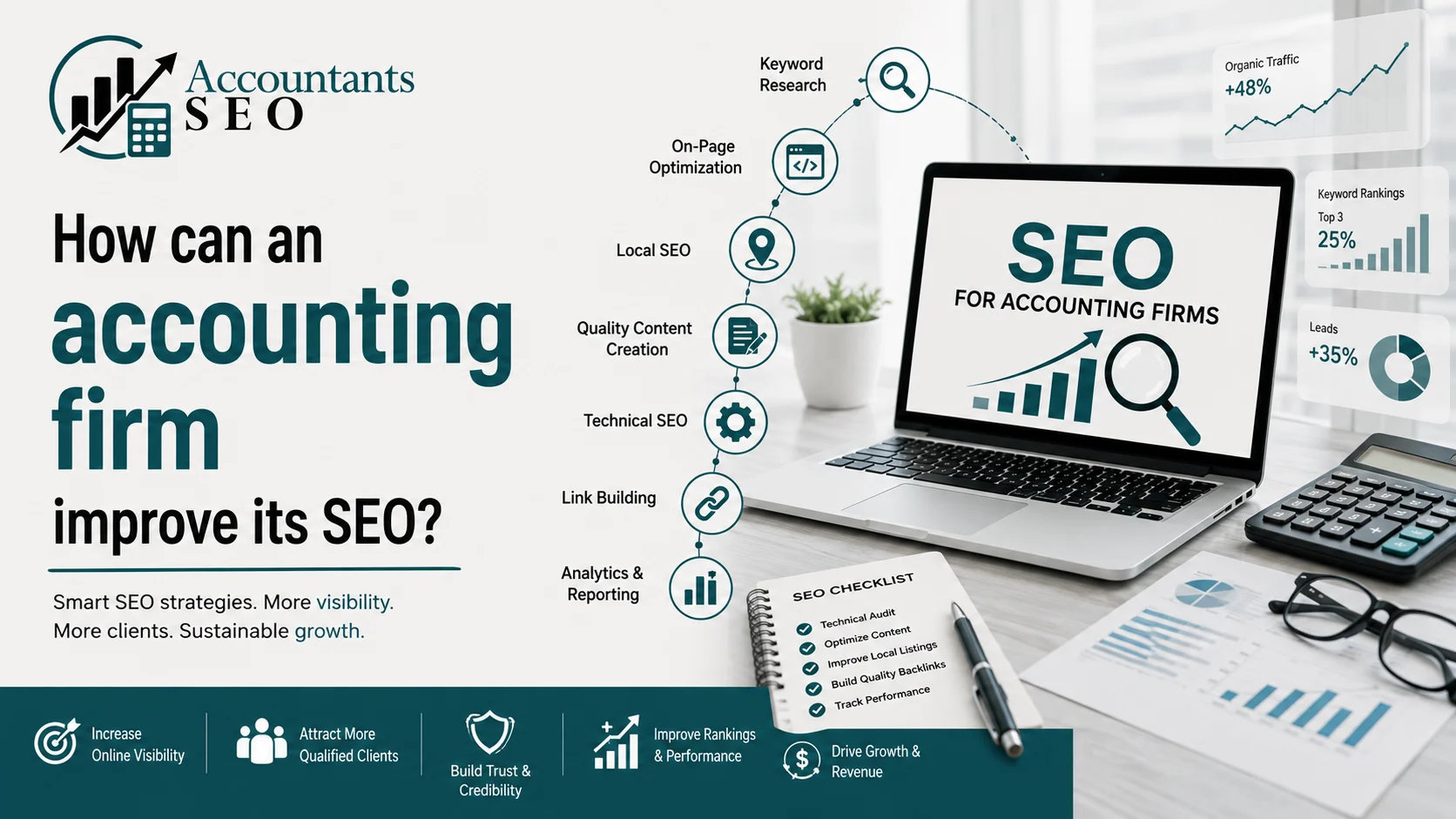
In today’s digital-first world, most people searching for accounting services begin with a Google search. Whether they need tax planning, bookkeeping, payroll management, financial consulting, or business accounting, potential clients are looking for trustworthy firms online before making contact. If your accounting firm isn’t appearing on the first page of search results, you’re likely losing qualified leads to competitors who have invested in search engine optimization (SEO).
SEO is much more than adding keywords to your website. It involves creating valuable content, improving website performance, building authority, optimizing for local searches, and ensuring an excellent user experience. Search engines have become smarter than ever, rewarding websites that genuinely help users solve their problems.
For accounting firms, SEO offers one of the highest long-term returns on investment. Unlike paid advertising that stops generating leads once the budget runs out, SEO continues bringing organic traffic month after month. Firms that consistently publish helpful content, optimize their local presence, and demonstrate expertise often establish themselves as trusted financial advisors in their communities.
This comprehensive guide explains exactly how an accounting firm can improve its SEO, attract more qualified leads, and build a sustainable online presence that delivers measurable business growth.
Why SEO Matters for Accounting Firms
Search engine optimization has become one of the most powerful digital marketing strategies for accounting firms of every size. Whether you’re an independent CPA, a regional accounting practice, or a nationwide financial advisory company, your prospective clients are actively searching online for solutions to their financial challenges. Appearing prominently in search results allows your business to connect with people at the exact moment they need professional accounting assistance.
Today’s clients rarely rely solely on referrals. Instead, they compare firms online, read reviews, visit websites, and evaluate expertise before making a decision. A professionally optimized website builds credibility before the first conversation even begins. This is especially important in accounting, where trust, expertise, and professionalism heavily influence purchasing decisions.
SEO also provides long-term value. While paid advertisements generate immediate visibility, they require ongoing investment to maintain results. Organic rankings, on the other hand, can continue generating qualified traffic for months or even years after content is published. This makes SEO one of the most cost-effective marketing channels available to accounting firms.
Beyond generating leads, SEO enhances brand recognition. When your articles consistently answer common accounting questions, potential clients begin viewing your firm as an authority. This trust significantly increases the likelihood that visitors will contact your business when they need accounting services.
Changing Client Search Behavior
Consumer behavior has changed dramatically over the past decade. Business owners, freelancers, startups, and individuals now research financial services independently before contacting an accountant. They search phrases such as:
- best accountant near me
- small business tax accountant
- bookkeeping services
- corporate tax consultant
- payroll accounting services
- CPA for startups
Each of these searches represents a potential client actively looking for professional help. If your website doesn’t appear prominently, another accounting firm will capture that opportunity.
Search engines also prioritize websites that demonstrate expertise through informative content. Publishing detailed guides on tax planning, bookkeeping, VAT compliance, business registration, or financial reporting increases your chances of ranking for valuable search queries while educating potential clients.
Benefits of Organic Traffic
Organic traffic differs significantly from visitors arriving through paid advertising or social media. These users actively searched for accounting-related information, meaning they already have intent. They may need immediate assistance or be researching future financial decisions.
Some of the biggest benefits include:
| Benefit | Impact on Accounting Firms |
| Higher trust | Organic rankings build credibility. |
| Better ROI | Long-term traffic without paying per click. |
| Qualified leads | Visitors actively searching for accounting help. |
| Brand authority | Educational content establishes expertise. |
| Sustainable growth | Rankings continue generating traffic over time. |
Organic visitors also tend to spend more time exploring your services because they intentionally searched for relevant information. This often results in higher consultation requests and improved conversion rates.
Understand Your Target Audience
Successful SEO begins with understanding who your ideal clients are. Every accounting firm serves different audiences, and each audience searches differently. A firm specializing in startups should optimize for different keywords than one focusing on multinational corporations or individual tax returns.
Develop detailed client personas by considering factors such as:
- Business size
- Industry
- Geographic location
- Financial challenges
- Budget
- Search habits
- Frequently asked questions
For example, a restaurant owner may search for “restaurant accountant” while a freelancer searches for “self-employed tax accountant.” Understanding these differences enables you to create highly relevant content that directly addresses each audience’s needs.
You should also identify where clients are in the buying journey. Some visitors simply want educational information, while others are ready to hire immediately. Your content strategy should serve both groups by providing informative articles alongside optimized service pages that encourage consultation requests.
Research Search Intent
Search intent refers to the reason behind a user’s query. Google increasingly rewards pages that satisfy search intent rather than simply repeating keywords.
Accounting-related searches generally fall into four categories:
| Search Intent | Example |
| Informational | How to file business taxes |
| Commercial | Best accounting firm for startups |
| Transactional | Hire CPA near me |
| Navigational | XYZ Accounting contact |
Your website should include content targeting each stage of this journey. Educational blog posts attract early-stage researchers, while service pages convert users ready to hire an accountant.
Perform Comprehensive Keyword Research
Keyword research is the foundation of every successful SEO strategy. Before creating content or optimizing your website, you need to understand exactly what your potential clients are searching for. Rather than guessing, use keyword research tools to identify search terms with a healthy balance of search volume, relevance, and ranking difficulty. Your goal is not simply to attract visitors but to attract people who are genuinely looking for accounting services.
Many accounting firms make the mistake of targeting only broad keywords like “accounting services” or “CPA.” While these phrases receive significant search volume, they are also extremely competitive. A smarter strategy combines high-volume keywords with long-tail phrases that reflect specific client needs.
For example, phrases like “tax accountant for small business,” “bookkeeping services for restaurants,” or “corporate tax consultant near me” often convert better because they indicate stronger purchase intent.
A well-rounded keyword strategy should include a mix of service-based, location-based, informational, and industry-specific terms. This allows your website to capture visitors at different stages of the buying journey. Someone searching for “how to reduce business taxes legally” may not hire an accountant immediately, but if your content provides valuable guidance, they are more likely to remember your firm when professional assistance becomes necessary.
Primary Keywords
Primary keywords should target your core services. These are typically incorporated into homepage content, service pages, and main landing pages.
Examples include:
- Accounting firm
- Accounting services
- Certified Public Accountant
- Tax accountant
- Bookkeeping services
- Payroll services
- Business accounting
- Financial consulting
- Corporate tax services
Each primary keyword should have its own optimized page whenever possible rather than combining multiple unrelated services onto a single page.
Long-Tail Keywords
Long-tail keywords usually contain three or more words and answer highly specific search queries. Although individual search volumes may be smaller, these keywords generally produce higher conversion rates because the searcher’s intent is much clearer.
Examples include:
- Best accountant for small business
- Tax preparation services near me
- Online accounting services for startups
- Monthly bookkeeping services
- Affordable CPA for freelancers
- Payroll accountant for healthcare companies
- Year-end tax planning services
Building content around these phrases increases your opportunities to rank for hundreds of related searches while attracting qualified leads.
Optimize Your Website for Search Engines
Even the best content cannot rank consistently if the website itself performs poorly. Search engines evaluate hundreds of technical signals when determining rankings, including page speed, security, mobile usability, structured data, crawlability, and overall user experience. An optimized website helps search engines understand your content while making navigation easier for visitors.
A professionally designed accounting website should communicate trust immediately. Visitors should quickly find your services, credentials, contact information, and client testimonials without unnecessary distractions. Every page should have a clear purpose and guide users toward booking a consultation or requesting more information.
Website optimization also includes creating logical site architecture. Search engines favor websites where pages are organized into clear categories with internal links connecting related content. For example, a page about bookkeeping services should naturally link to payroll services, tax planning, and relevant educational articles.
Technical SEO
Technical SEO ensures search engines can properly crawl, index, and understand your website. Without a strong technical foundation, even outstanding content may struggle to rank.
Important technical improvements include:
- HTTPS security
- XML sitemap
- Robots.txt optimization
- Clean URL structure
- Structured data markup
- Broken link fixes
- Canonical tags
- Optimized navigation
- Proper heading hierarchy
- Image optimization
Regular technical audits help identify hidden issues before they negatively affect rankings.
Website Speed
Website speed directly impacts both rankings and user experience. Research consistently shows that visitors abandon slow websites within seconds. Every additional second of loading time can reduce conversions and increase bounce rates.
Accounting firms can improve speed by:
- Compressing images
- Using modern image formats
- Enabling browser caching
- Minimizing CSS and JavaScript
- Using a Content Delivery Network (CDN)
- Choosing reliable hosting
- Removing unnecessary plugins
Fast-loading pages improve visitor satisfaction while sending positive engagement signals to search engines.
Mobile Friendliness
More than half of all internet searches now occur on smartphones. Google’s mobile-first indexing means the mobile version of your website plays a major role in determining search rankings.
A mobile-friendly accounting website should feature:
- Responsive design
- Readable text without zooming
- Fast mobile loading speeds
- Clickable buttons
- Simple navigation menus
- Optimized contact forms
Clients searching for an accountant often need immediate assistance, making mobile usability especially important.
On-Page SEO Best Practices
On-page SEO involves optimizing individual pages to improve their visibility in search results. Every service page and blog article should be carefully structured around a primary keyword while remaining natural and informative.
Essential on-page optimization includes:
| Element | SEO Best Practice |
| Title Tag | Include primary keyword near the beginning. |
| Meta Description | Write compelling summaries encouraging clicks. |
| URL | Keep URLs short and keyword-focused. |
| H1 Heading | Use one descriptive H1 per page. |
| H2 & H3 Headings | Organize content logically. |
| Images | Add descriptive filenames and alt text. |
| Internal Links | Connect related service pages and blogs. |
| External Links | Reference authoritative financial resources when relevant. |
Avoid keyword stuffing. Modern SEO rewards content that answers user questions naturally rather than repeating keywords excessively.
Create SEO-Friendly URLs
Simple URLs are easier for both users and search engines to understand. Instead of using long or confusing web addresses, create descriptive URLs that include your target keyword.
Good Examples
- /tax-planning-services
- /bookkeeping-services
- /small-business-accounting
- /payroll-management
Avoid
- /page?id=728
- /services123
- /new-page-final-version
Clean URLs improve click-through rates and help search engines categorize your content correctly.
Optimize Title Tags and Meta Descriptions
Although users may never notice them directly on your website, title tags and meta descriptions are among the most important SEO elements. These appear in Google search results and influence whether users click your listing.
A strong title tag should:
- Include the primary keyword
- Stay within recommended character limits
- Clearly describe the page
- Encourage clicks
Example:
Small Business Accounting Services | Trusted CPA Firm
A compelling meta description summarizes the page while highlighting its value.
Example:
“Looking for reliable accounting services? Our experienced CPAs provide tax planning, bookkeeping, payroll, and financial consulting for businesses of all sizes.”
Higher click-through rates often contribute to improved search visibility over time.
Build a Strong Internal Linking Strategy
Internal links help both visitors and search engines discover more of your content. Rather than leaving blog articles isolated, connect them with relevant service pages and other educational resources.
For example:
- A blog about tax deductions can link to your tax preparation service.
- A payroll article can link to bookkeeping services.
- A startup accounting guide can link to business advisory services.
Effective internal linking distributes authority throughout your website while encouraging visitors to explore additional pages. It also reduces bounce rates and increases the amount of time users spend on your site—both positive engagement signals for SEO.
Optimize Images for Better SEO
Images improve user engagement, but if they are not optimized, they can slow down your website and reduce search performance. Every image should have a descriptive filename, compressed file size, and meaningful alt text that accurately describes the visual content.
For example, instead of uploading an image named IMG12345.jpg, rename it to small-business-accounting-services.jpg. Likewise, use alt text such as “Accountant reviewing financial reports for a small business client.” These simple improvements help search engines understand your images while also improving accessibility for users who rely on screen readers.
Using modern image formats like WebP, lazy loading, and responsive image sizes further enhances website performance. Faster-loading pages create a better experience for visitors and contribute to stronger SEO results over time.
Frequently Asked Questions (FAQs)
1. Why is SEO important for an accounting firm?
SEO helps accounting firms appear higher in search engine results when potential clients search for services like tax preparation, bookkeeping, payroll, or financial consulting. Higher rankings increase website traffic, build credibility, and generate more qualified leads without relying solely on paid advertising.
2. What are the best keywords for an accounting firm’s SEO?
The best keywords depend on your services and target audience. Common examples include accounting firm, tax accountant, bookkeeping services, CPA near me, small business accounting, payroll services, financial consulting, and long-tail keywords such as best accountant for startups or tax preparation services for small businesses.
3. How long does SEO take to show results for an accounting firm?
SEO is a long-term marketing strategy. Most accounting firms begin seeing measurable improvements within 3 to 6 months, while more competitive keywords may take 6 to 12 months to achieve strong rankings. Consistent content creation, technical optimization, and quality backlinks help accelerate results.
4. How can local SEO help an accounting firm get more clients?
Local SEO improves visibility for location-based searches such as “accountant near me“ or “CPA in [city]”. Optimizing your Google Business Profile, earning positive client reviews, maintaining accurate business information, and creating location-specific service pages can significantly increase local inquiries and appointments.
5. What is the most effective SEO strategy for an accounting firm?
The most effective approach combines several proven tactics, including comprehensive keyword research, publishing high-quality educational content, optimizing service pages, improving website speed, strengthening technical SEO, building authoritative backlinks, and maintaining an optimized Google Business Profile. Together, these strategies improve search rankings, attract targeted traffic, and increase client conversions.