

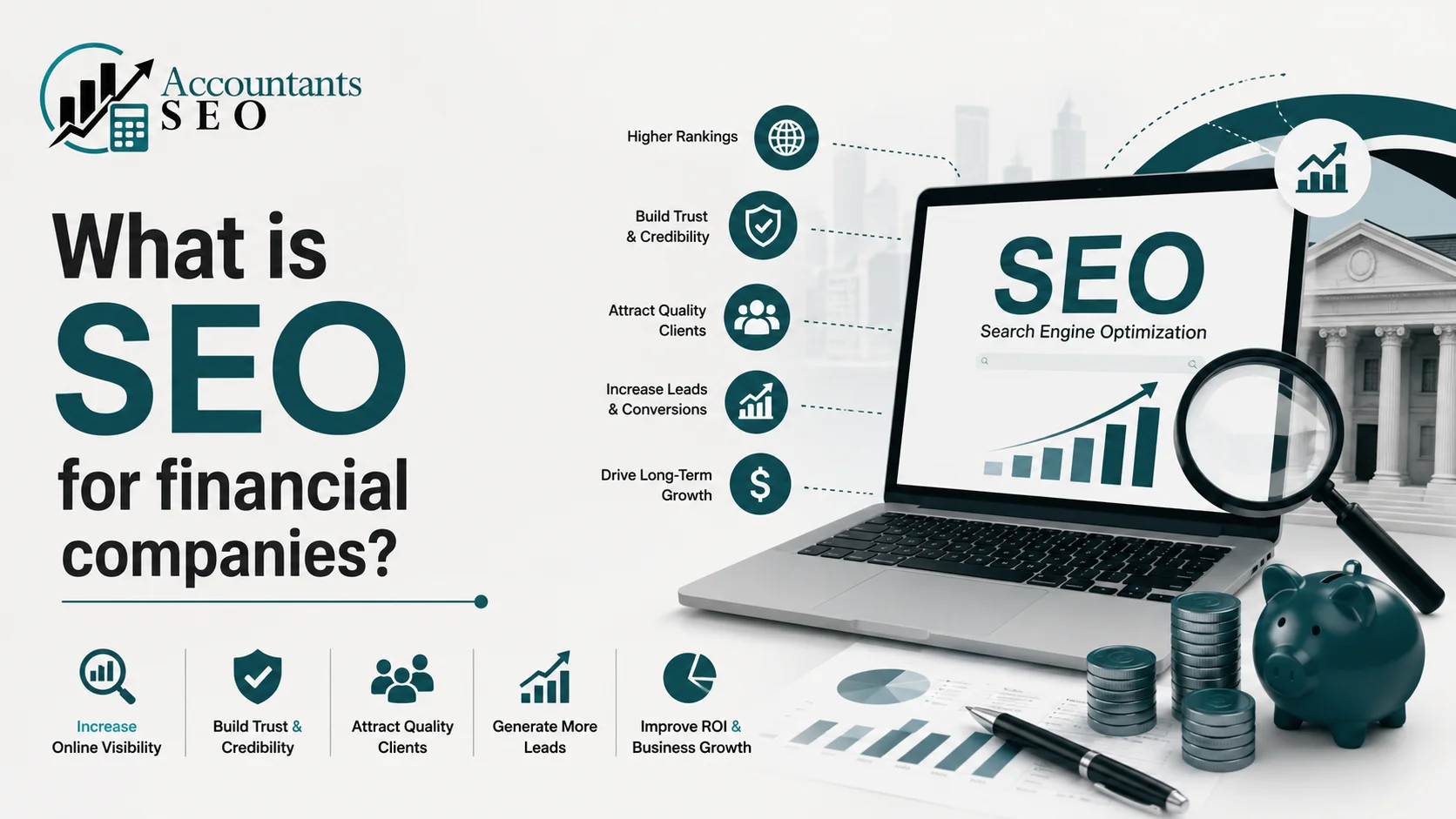
The financial industry has become more competitive than ever, with banks, insurance companies, investment firms, accounting agencies, fintech startups, and financial advisors all competing for online visibility. Today, most customers begin their search for financial services on Google before contacting a company. Whether someone is searching for mortgage advice, investment planning, tax consultation, or business loans, they typically choose one of the websites appearing on the first page of search results.
This is where SEO for financial companies becomes essential. Search Engine Optimization (SEO) helps financial businesses improve their rankings, attract qualified traffic, build trust, and convert visitors into long-term clients. Because financial websites fall under Google’s Your Money or Your Life (YMYL) category, SEO requires greater expertise, authority, and credibility than many other industries.
Understanding Financial SEO
SEO for financial companies refers to the process of optimizing a financial website so it ranks higher in search engines like Google for relevant searches. Unlike general SEO, financial SEO focuses on industries where trust, accuracy, and expertise directly affect users’ financial decisions. Banks, credit unions, investment firms, insurance agencies, tax consultants, mortgage brokers, accounting firms, and fintech companies all benefit from a strong SEO strategy.
A successful financial SEO campaign combines technical website optimization, keyword research, content marketing, local SEO, authority building, and user experience improvements. Since financial websites are categorized under Google’s YMYL (Your Money or Your Life) content, they are held to much higher quality standards than ordinary websites. Every article, service page, and blog should demonstrate expertise, provide accurate information, and establish credibility. Companies that consistently publish valuable financial content and maintain technically sound websites are more likely to earn higher rankings and long-term organic traffic.
Why SEO Matters for Financial Businesses
Consumers increasingly rely on search engines before choosing financial services. Instead of visiting multiple offices, people compare reviews, pricing, services, and expertise online. If your website doesn’t appear on Google’s first page, potential customers are far more likely to choose a competitor.
SEO offers long-term benefits that paid advertising alone cannot provide. While PPC campaigns stop generating traffic when the budget ends, SEO continues delivering qualified visitors over time. Financial companies investing in SEO build sustainable visibility, increase brand awareness, and improve customer trust. High-ranking websites are often perceived as more reliable because users associate top search positions with authority and credibility.
Another major advantage is lead quality. Visitors arriving through organic search usually have clear intent. Someone searching for “best retirement planning advisor” or “small business accountant near me” is already looking for professional assistance. Optimizing your website for these search queries increases the likelihood of converting visitors into paying clients.
How Google Evaluates Financial Websites
Google treats financial websites differently from many other industries because they directly influence people’s money, investments, savings, and financial security. A poorly written article about entertainment might simply confuse readers, but inaccurate financial advice can lead to significant financial losses. For this reason, Google classifies finance-related websites as Your Money or Your Life (YMYL) websites. Pages that fall into this category must demonstrate a high level of quality, transparency, and expertise before they can achieve strong rankings. Financial companies that ignore these quality standards often struggle to compete, even if they invest heavily in traditional SEO techniques.
One of Google’s most important evaluation frameworks is EEAT, which stands for Experience, Expertise, Authoritativeness, and Trustworthiness. Financial businesses should clearly display author credentials, company information, contact details, privacy policies, and accurate references wherever appropriate. Articles written or reviewed by qualified financial professionals tend to inspire greater confidence among both users and search engines. Building trust also involves maintaining secure HTTPS connections, publishing updated content, responding to customer reviews, and ensuring factual accuracy across every page. A trustworthy financial website doesn’t simply rank better—it also converts more visitors into loyal clients because users feel confident relying on the information provided.
Keyword Research for Financial Companies
Keyword research is the backbone of every successful SEO strategy. Instead of targeting broad and highly competitive keywords such as finance or banking, financial companies should identify search phrases that closely match user intent. Understanding what potential customers are actually searching for helps businesses create pages that answer specific questions while increasing the chances of attracting qualified traffic.
Long-tail keywords generally have lower competition and higher conversion rates because they target users who already know what service they need.
Financial companies should organize keywords into several categories. Informational keywords attract users looking to learn about financial topics, while commercial keywords target users ready to purchase a service. Local keywords help businesses reach nearby customers searching for accountants, financial advisors, or mortgage brokers in specific cities. Transactional keywords focus on users prepared to contact a company or request a consultation. Examples include:
| Keyword Type | Example |
| Informational | What is financial planning? |
| Commercial | Best financial advisor for retirement |
| Transactional | Hire tax consultant near me |
| Local | Financial advisor in Dubai |
| Service-Based | Investment management services |
A balanced keyword strategy allows financial businesses to capture visitors at every stage of the customer journey, from initial research to final decision-making.
On-Page SEO Best Practices
On-page SEO involves optimizing every page of your website so both users and search engines clearly understand its purpose. Each service page should focus on one primary keyword while naturally incorporating related terms throughout headings, paragraphs, image alt text, and meta descriptions. Keyword stuffing should always be avoided because Google prioritizes natural language that genuinely helps readers rather than repetitive phrases inserted solely for ranking purposes.
Content quality remains the most important ranking factor for financial websites. Every article should answer common customer questions thoroughly while providing practical insights backed by credible sources whenever appropriate. Internal linking strengthens website architecture by connecting related pages, allowing users to explore additional services and helping search engines crawl the site more efficiently.
Optimized title tags, compelling meta descriptions, structured headings, and descriptive URLs further improve visibility and click-through rates. Fast-loading images, mobile-friendly layouts, and easy navigation all contribute to a better user experience, increasing the likelihood that visitors will stay on the website longer and eventually become customers.
Technical SEO Requirements
Even exceptional content cannot perform well if a website suffers from technical issues. Technical SEO ensures that search engines can crawl, index, and understand every page without encountering unnecessary obstacles. Financial companies should prioritize website speed because users expect pages to load within seconds. Slow websites often experience higher bounce rates, lower engagement, and reduced search rankings.
Mobile optimization has become equally important as more users search for financial services using smartphones and tablets. Responsive website design ensures that content displays correctly on every device, improving both usability and SEO performance. Financial businesses should also implement HTTPS encryption, XML sitemaps, structured schema markup, canonical tags, and optimized Core Web Vitals.
Regular technical audits help identify broken links, duplicate content, crawl errors, and indexing issues before they negatively impact rankings. A technically healthy website creates a strong foundation upon which every other SEO effort can succeed.
Local SEO for Financial Firms
Many financial companies serve customers within specific geographic regions, making local SEO one of the most valuable digital marketing strategies available. Whether operating as an accounting firm, insurance agency, wealth management company, mortgage broker, or tax consultant, appearing in local search results significantly increases visibility among nearby customers. Users frequently search phrases like “financial advisor near me” or “tax accountant in my city,” making location-based optimization essential.
An optimized Google Business Profile plays a central role in local SEO success. Businesses should maintain accurate contact information, office hours, service descriptions, and high-quality images while actively encouraging satisfied clients to leave reviews. Positive reviews improve credibility and influence both rankings and customer decisions.
Local citations across trusted business directories should remain consistent to strengthen search engine confidence. Publishing localized content, earning backlinks from regional organizations, and creating city-specific landing pages can further improve local rankings while attracting highly targeted traffic that is more likely to convert into consultations and long-term client relationships.
Frequently Asked Questions (FAQs)
1. Why is SEO important for financial companies?
SEO helps financial companies increase their online visibility, attract qualified leads, and build trust with potential clients. Since most people search online before choosing financial services, ranking higher in search results can generate consistent organic traffic and reduce dependence on paid advertising.
2. What are the best SEO strategies for financial services?
The most effective SEO strategies include keyword research, creating high-quality educational content, optimizing technical SEO, improving website speed, earning authoritative backlinks, optimizing local SEO, and regularly updating content to match Google’s latest guidelines.
3. How long does SEO take to show results for financial companies?
SEO is a long-term marketing strategy. Most financial companies begin seeing noticeable improvements within 3 to 6 months, while highly competitive keywords may take 6 to 12 months or longer, depending on the website’s authority and the quality of the SEO campaign.
4. What types of financial businesses can benefit from SEO?
Almost every financial business can benefit from SEO, including accounting firms, tax consultants, financial advisors, wealth management firms, investment companies, insurance agencies, mortgage brokers, fintech companies, bookkeeping services, and credit repair businesses.
5. Can small financial firms compete with large brands using SEO?
Yes. Small financial firms can compete successfully by targeting niche and local keywords, publishing valuable content that answers customer questions, optimizing their Google Business Profile, and demonstrating expertise through trustworthy, experience-based content. A focused SEO strategy often delivers better long-term results than relying solely on paid advertising.